Head to head
Bubble vs Lovable (2026)
Lovable takes the overall rating, but this pairing is decided on axes rather than totals: Bubble leads 1 of the ten, Lovable leads 8.

Bubble
The old guard of no-code, still the deepest and still the most expensive to outgrow
3.5out of 5
Still the most capable platform here, still the hardest to leave. Bubble scores 4.5 on integrations because thirteen years of plugins and a large contractor market genuinely solve problems the AI-native tools cannot, and its native mobile story is better than we published: the vendor's own FAQ says "In Bubble, native mobile apps run on React Native", with store publishing, build submissions and unlimited over-the-air updates, so calling it a wrapper was inaccurate. The Data and Workflow APIs are real and useful. What does not exist is an MCP server: the vendor's March 2026 founder AMA says it is "on our radar, but not on the roadmap yet", the editor API is not open either, and every "Bubble MCP" you will find is a community project on forum.bubble.io. The other costs are unchanged: no code export at all, one of the weakest performance profiles in the index at 3.0 on speed, and workload pricing that surprises people in month three, though storage at least is published flatly at USD 3 per 100 GB a month. Choose it deliberately, with an exit you have accepted you do not have.
- Price from
- USD 59 / month, billed annually
- Best for
- Complex operational products where the plugin ecosystem and the contractor pool matter more than speed
- Ratings
- 42

Lovable
The chat-first full-stack builder that most teams try first
4.2out of 5
Buy, with one eye on the meter. Lovable is the most complete of the chat-first builders: the generated interfaces are the best looking of any chat-first builder here by a clear margin, the Supabase integration means auth and a real relational database arrive in the first ten minutes rather than the third week, and the GitHub sync is honest two-way sync rather than a zip download. Our panel built the same booking app on every tool in the launch cohort; Lovable was one of only four that produced something we would have been willing to put in front of a paying customer without a rewrite. What you are buying is the first eighty percent, delivered faster and prettier than anywhere else.
- Price from
- USD 25 / month, billed monthly
- Best for
- Founders and product teams who want a good-looking, genuinely deployable SaaS front end in an afternoon
- Ratings
- 118
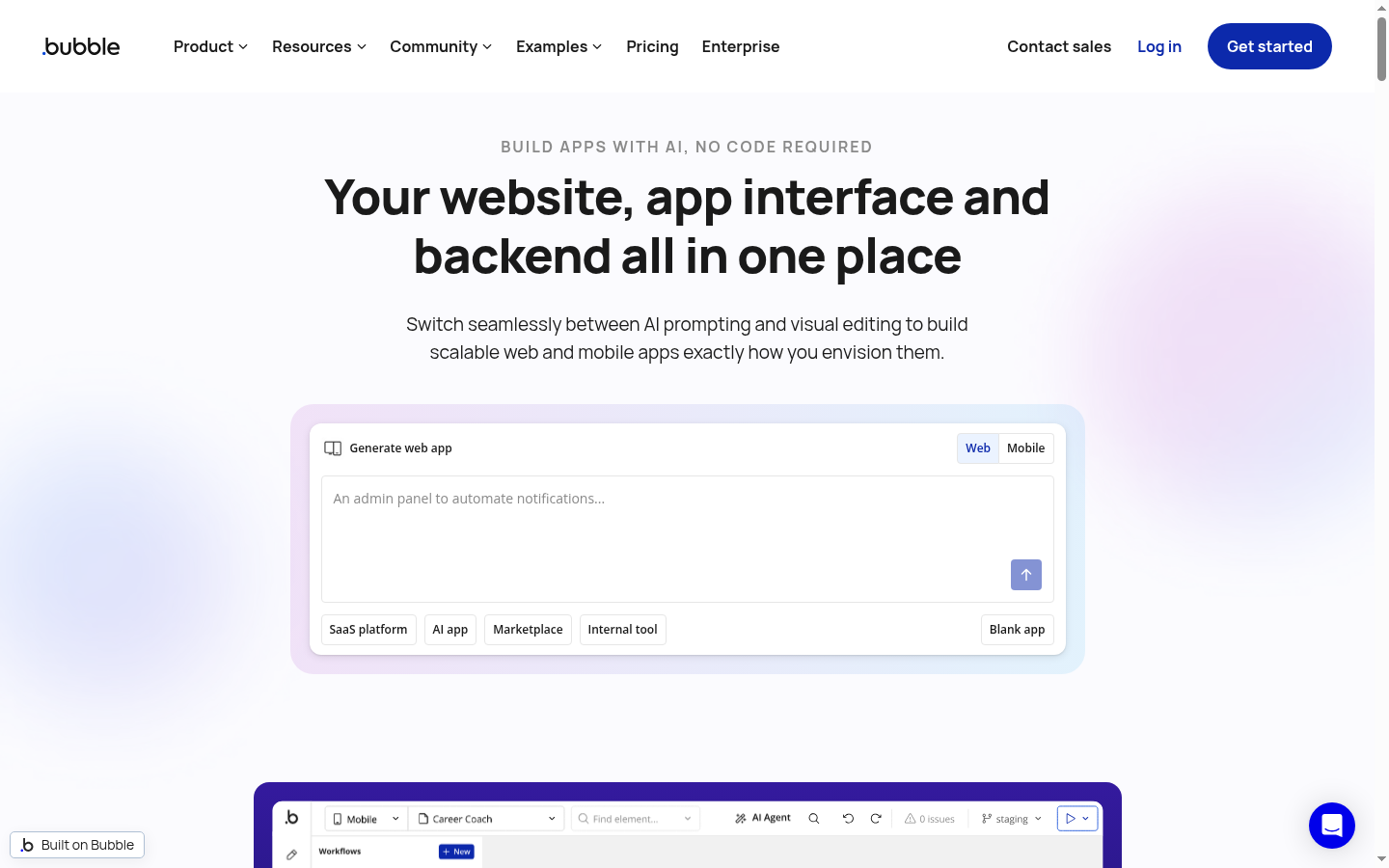
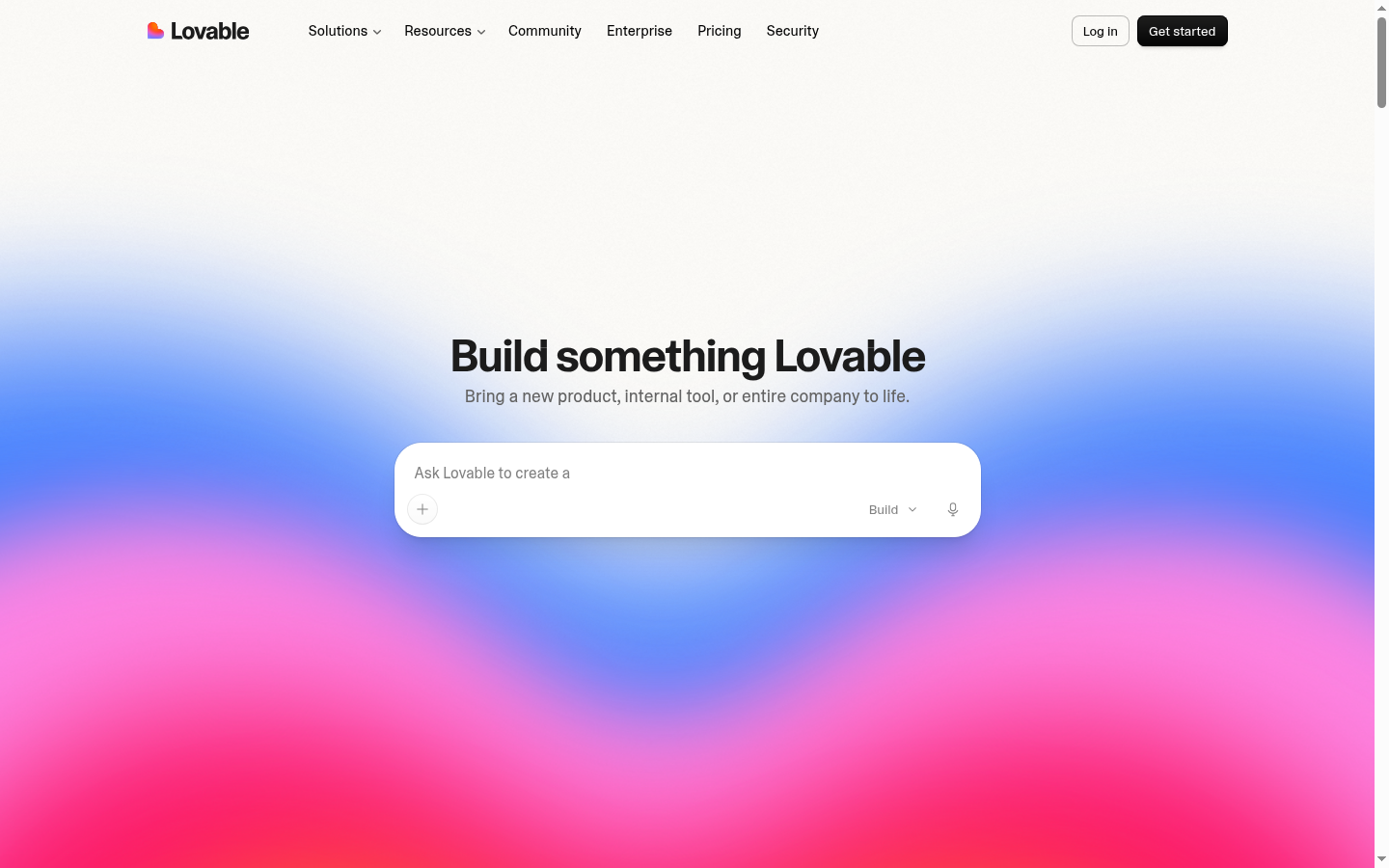
What each one looks like
Axis by axis
The leader on each axis is set in bold. The weight column is what that axis contributes to the overall rating, so a win on reliability counts for more than five times a win on code ownership.
| Axis | Weight | Bubble | Lovable | Leader |
|---|---|---|---|---|
| Reliability | 16% | 4.2 | 4.0 | Bubble |
| Integrations | 16% | 4.5 | 4.5 | Tied |
| SEO and GEO | 13% | 3.2 | 4.0 | Lovable |
| Design quality | 12% | 3.4 | 4.7 | Lovable |
| Agent performance | 10% | 3.1 | 4.4 | Lovable |
| Speed | 9% | 3.0 | 4.6 | Lovable |
| Value | 9% | 2.8 | 3.9 | Lovable |
| Scalability | 7% | 3.6 | 3.8 | Lovable |
| API and MCP access | 5% | 3.2 | 4.0 | Lovable |
| Code ownership | 3% | 2.2 | 4.5 | Lovable |
| Overall, weighted | 100% | 3.5 | 4.2 | Lovable |
Axis definitions and the full weighting are on how we review. Both tools last verified 20 August 2026.
Where the capabilities differ
| Capability | Bubble | Lovable |
|---|---|---|
| Full-stack backend | Yes | Yes |
| Database included | Yes, own store | Yes, Supabase Postgres |
| Auth included | Yes, with privacy rules | Yes |
| Code export | No | Yes, full repository |
| GitHub sync | No | Yes, two-way |
| One-click deploy | Yes | Yes |
| Custom domain | Yes, paid plans | Yes, paid plans |
| Mobile or native output | Native mobile apps run on React Native, with store publishing, build submissions and unlimited over-the-air updates | Responsive web only |
| Team collaboration | Yes, paid plans | Yes, paid plans |
| Public API or MCP server | Data and Workflow APIs, yes. No official MCP server, the editor API is not open, and every Bubble MCP in circulation is a community project | Yes |
| Self-hosting the output | No | Yes, you own the repo |
Shaded rows are the ones where the two differ.
What each one costs
Bubble
Free plan for building and testing only: it cannot buy workload tiers or enable overages, so it hard-stops at 50K workload units. Paid plans from USD 69 a month plus workload charges.
Starter plan, billed annually. USD 69 billed monthly. Growth is USD 249 and Team USD 649 billed monthly.
| Plan | Price |
|---|---|
| Free | Free |
| Starter | USD 69 |
| Growth | USD 249 |
| Team | USD 649 |
| Enterprise | On request |
| Agency | On request |
Lovable
Free plan with a monthly credit allowance. Pro at USD 25 a month, with credit top-ups sold separately.
Pro plan.
| Plan | Price |
|---|---|
| Free | Free |
| Pro | USD 25 |
| Business | Not captured |
| Enterprise | On request |
Prices are shown in the currency each vendor publishes, never converted. Sorting by price groups the currencies and orders within each one, so it is not an exact cross-currency comparison.
We list the plans we could verify on the vendor's own pricing page. Where a plan exists but its price was not published in a form we could capture, the row says so rather than carrying a number we cannot source.
Which one should you choose
Pick Bubble if your project looks like complex operational products where the plugin ecosystem and the contractor pool matter more than speed. Its strongest axes in this pairing are reliability. Avoid it for anyone who needs to leave with the code, or who is judged on page speed.
Pick Lovable if your project looks like founders and product teams who want a good-looking, genuinely deployable saas front end in an afternoon. Its strongest axes here are seo and geo, design quality, agent performance. Avoid it for teams with heavy custom backend logic, strict data residency rules, or a fixed monthly budget they cannot exceed.
And the dissenting notes, which we publish rather than average away: on Bubble, The testing lead wanted a lower reliability mark after two workload throttles during our runs. The rest of the panel held at 4.2, on the grounds that throttling under load is a pricing failure rather than a reliability failure. On Lovable, The dissent is about the last twenty percent and what it costs. Two of our five panellists argued Lovable should score below Replit, because the moment your app stops looking like a CRUD dashboard the agent starts burning credits on repeated near-misses, and the credit model turns debugging into a metered activity. One reviewer spent 40 credits fixing a row-level security policy that a developer would have fixed in nine minutes. If you already have engineers, they contend, you are paying a premium for scaffolding you could generate once and own forever.
Frequently asked
- Is Bubble better than Lovable?
- On our weighted overall rating, Lovable scores higher: 3.5 for Bubble against 4.2 for Lovable. Axis by axis it is closer than that sounds. Bubble leads 1 of the 10 axes that apply to both, Lovable leads 8, and 1 are tied. The right choice depends on which axes you weight, not on which total is larger.
- Which is cheaper, Bubble or Lovable?
- Bubble starts at USD 59 / month, billed annually and Lovable starts at USD 25 / month, billed monthly. Each figure is the vendor's own published price and currency, not converted, so compare the pricing models rather than the two numbers: Bubble bills as free plan for building and testing only: it cannot buy workload tiers or enable overages, so it hard-stops at 50k workload units. paid plans from usd 69 a month plus workload charges. and Lovable bills as free plan with a monthly credit allowance. pro at usd 25 a month, with credit top-ups sold separately..
- Can I move a project from Bubble to Lovable?
- Only as far as code export allows. On the code ownership axis Bubble scores 2.2 and Lovable scores 4.5 out of five, which reflects how much of the running application you can take with you and whether it still works once moved.
- Which one is better for search visibility?
- On the SEO and GEO axis, which we weight at 13 percent, Bubble scores 3.2 and Lovable scores 4.0. That axis covers server rendered content, per route titles and canonicals, and whether the output is legible without JavaScript.