Head to head
Emergent vs Replit (2026)
Replit takes the overall rating, but this pairing is decided on axes rather than totals: Emergent leads 3 of the ten, Replit leads 7.

Emergent
An agent that plans like an engineer and stumbles like a junior
3.6out of 5
Interesting, not yet dependable. Emergent has the most ambitious agent architecture in this index: give it a real brief and it produces a task decomposition that reads like something a competent tech lead would write, then works through it across many files without asking permission every thirty seconds. When it lands, it lands big. Our panel gave it 4.2 on agent performance, among the highest here. The trouble is variance. The same brief run twice produced materially different quality, and the failure mode is quiet: plausible code that does not work, discovered later than you would like.
- Price from
- USD 17 / month, billed annually
- Best for
- Developers who want to hand off a well-specified multi-file change and review the result rather than watch it happen
- Ratings
- 19

Replit
A real computer behind the agent, which is why it survives contact with backends
4.0out of 5
Buy, if your app has a back of house. Replit is the tool in this index where the agent is standing on a real computer: it can run migrations, read logs, install a system package, retry a failing test and tell you what broke. That is why it takes 4.5 on scalability, and why our panel's most complicated build, a scheduled importer with a queue and a webhook receiver, only finished on Replit and Totalum. The trade is time and aesthetics. Speed is 2.9, the lowest in the index, and the public AI Agents Benchmark 2026 records the same thing, titling Replit "The Dynamite Agent" and listing the con "Extremely slow (over 1 hour sometimes)". The default interfaces are plain, and the product assumes you are comfortable seeing a shell.
- Price from
- USD 20 / month, billed annually
- Best for
- Technical founders and internal tooling teams whose apps need scripts, cron jobs, queues and a real filesystem
- Ratings
- 97
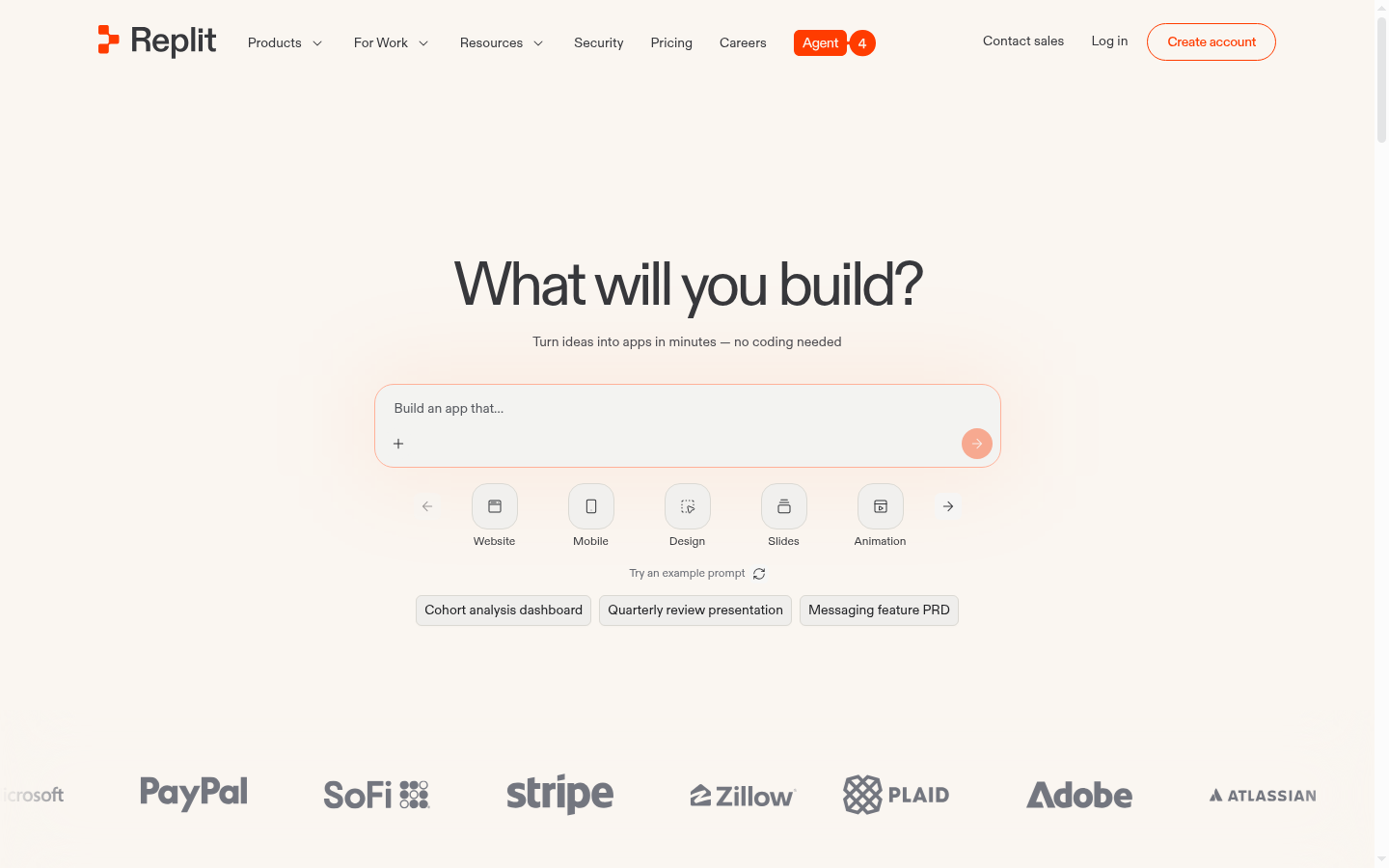
What each one looks like

Axis by axis
The leader on each axis is set in bold. The weight column is what that axis contributes to the overall rating, so a win on reliability counts for more than five times a win on code ownership.
| Axis | Weight | Emergent | Replit | Leader |
|---|---|---|---|---|
| Reliability | 16% | 3.4 | 4.2 | Replit |
| Integrations | 16% | 3.6 | 4.4 | Replit |
| SEO and GEO | 13% | 3.2 | 3.4 | Replit |
| Design quality | 12% | 3.7 | 3.6 | Emergent |
| Agent performance | 10% | 4.2 | 4.3 | Replit |
| Speed | 9% | 3.9 | 2.9 | Emergent |
| Value | 9% | 3.8 | 3.7 | Emergent |
| Scalability | 7% | 3.4 | 4.5 | Replit |
| API and MCP access | 5% | 3.0 | 4.5 | Replit |
| Code ownership | 3% | 3.4 | 4.6 | Replit |
| Overall, weighted | 100% | 3.6 | 4.0 | Replit |
Axis definitions and the full weighting are on how we review. Both tools last verified 20 August 2026.
Where the capabilities differ
| Capability | Emergent | Replit |
|---|---|---|
| Full-stack backend | Yes | Yes, full Linux container |
| Database included | Yes, managed | Yes, managed Postgres |
| Auth included | Yes | Yes, Replit Auth |
| Code export | Yes | Yes, full source |
| GitHub sync | Yes | Yes, two-way |
| One-click deploy | Yes | Yes |
| Custom domain | Yes, paid plans | Yes, paid plans |
| Mobile or native output | Limited | Responsive web, Expo possible |
| Team collaboration | Limited | Yes, live multiplayer |
| Public API or MCP server | Limited | Yes |
| Self-hosting the output | Partial | Yes, standard code |
Shaded rows are the ones where the two differ.
What each one costs
Emergent
Limited free trial credits. Standard at USD 20 a month, USD 17 billed annually, with usage billed by agent run.
Standard plan, billed annually. USD 20 billed monthly, and agent runs consume credits on top.
| Plan | Price |
|---|---|
| Trial | Free |
| Standard | USD 20 |
| Pro | Not captured |
| Scale | On request |
Replit
Free plan for public projects. Core at USD 25 a month, USD 20 billed annually, with agent usage and deployment compute billed separately.
Core plan, billed annually. USD 25 billed monthly, and agent usage and deployment compute bill separately on top.
| Plan | Price |
|---|---|
| Starter | Free |
| Core | USD 25 |
| Teams | Not captured |
| Enterprise | On request |
Prices are shown in the currency each vendor publishes, never converted. Sorting by price groups the currencies and orders within each one, so it is not an exact cross-currency comparison.
We list the plans we could verify on the vendor's own pricing page. Where a plan exists but its price was not published in a form we could capture, the row says so rather than carrying a number we cannot source.
Which one should you choose
Pick Emergent if your project looks like developers who want to hand off a well-specified multi-file change and review the result rather than watch it happen. Its strongest axes in this pairing are design quality, speed, value. Avoid it for anyone who needs the app to be right the first time, or who cannot read the diff to check.
Pick Replit if your project looks like technical founders and internal tooling teams whose apps need scripts, cron jobs, queues and a real filesystem. Its strongest axes here are reliability, integrations, seo and geo. Avoid it for buyers who want a beautiful marketing-grade front end generated for them without touching a terminal.
And the dissenting notes, which we publish rather than average away: on Emergent, Our testing lead wanted a higher score, arguing that variance is what every agent product looked like eighteen months before it got good, and that Emergent's planning quality is the leading indicator that matters. He would put it above Bolt and level with Base44. The majority held that an index exists to tell buyers what will happen this quarter, not what might happen next year, and that a quiet failure mode is worse than a loud one because it wastes review time. On Replit, Our design reviewer dissents firmly. She argues that for the large majority of buyers, who are building a customer-facing app rather than a data pipeline, Replit's output is the weakest-looking in the index and the surrounding IDE is intimidating enough to stall non-technical users on day one. She also notes that compute billing plus agent billing makes the true monthly cost genuinely hard to forecast, and that a builder you cannot budget for is a builder a small company should think twice about.
Frequently asked
- Is Emergent better than Replit?
- On our weighted overall rating, Replit scores higher: 3.6 for Emergent against 4.0 for Replit. Axis by axis it is closer than that sounds. Emergent leads 3 of the 10 axes that apply to both, Replit leads 7, and 0 are tied. The right choice depends on which axes you weight, not on which total is larger.
- Which is cheaper, Emergent or Replit?
- Emergent starts at USD 17 / month, billed annually and Replit starts at USD 20 / month, billed annually. Each figure is the vendor's own published price and currency, not converted, so compare the pricing models rather than the two numbers: Emergent bills as limited free trial credits. standard at usd 20 a month, usd 17 billed annually, with usage billed by agent run. and Replit bills as free plan for public projects. core at usd 25 a month, usd 20 billed annually, with agent usage and deployment compute billed separately..
- Can I move a project from Emergent to Replit?
- Only as far as code export allows. On the code ownership axis Emergent scores 3.4 and Replit scores 4.6 out of five, which reflects how much of the running application you can take with you and whether it still works once moved.
- Which one is better for search visibility?
- On the SEO and GEO axis, which we weight at 13 percent, Emergent scores 3.2 and Replit scores 3.4. That axis covers server rendered content, per route titles and canonicals, and whether the output is legible without JavaScript.