Head to head
Knack vs Airtable (2026)
Airtable takes the overall rating, but this pairing is decided on axes rather than totals: Knack leads 1 of the ten, Airtable leads 8.

Knack
A database-first tool that charges for records, never for people
3.4out of 5
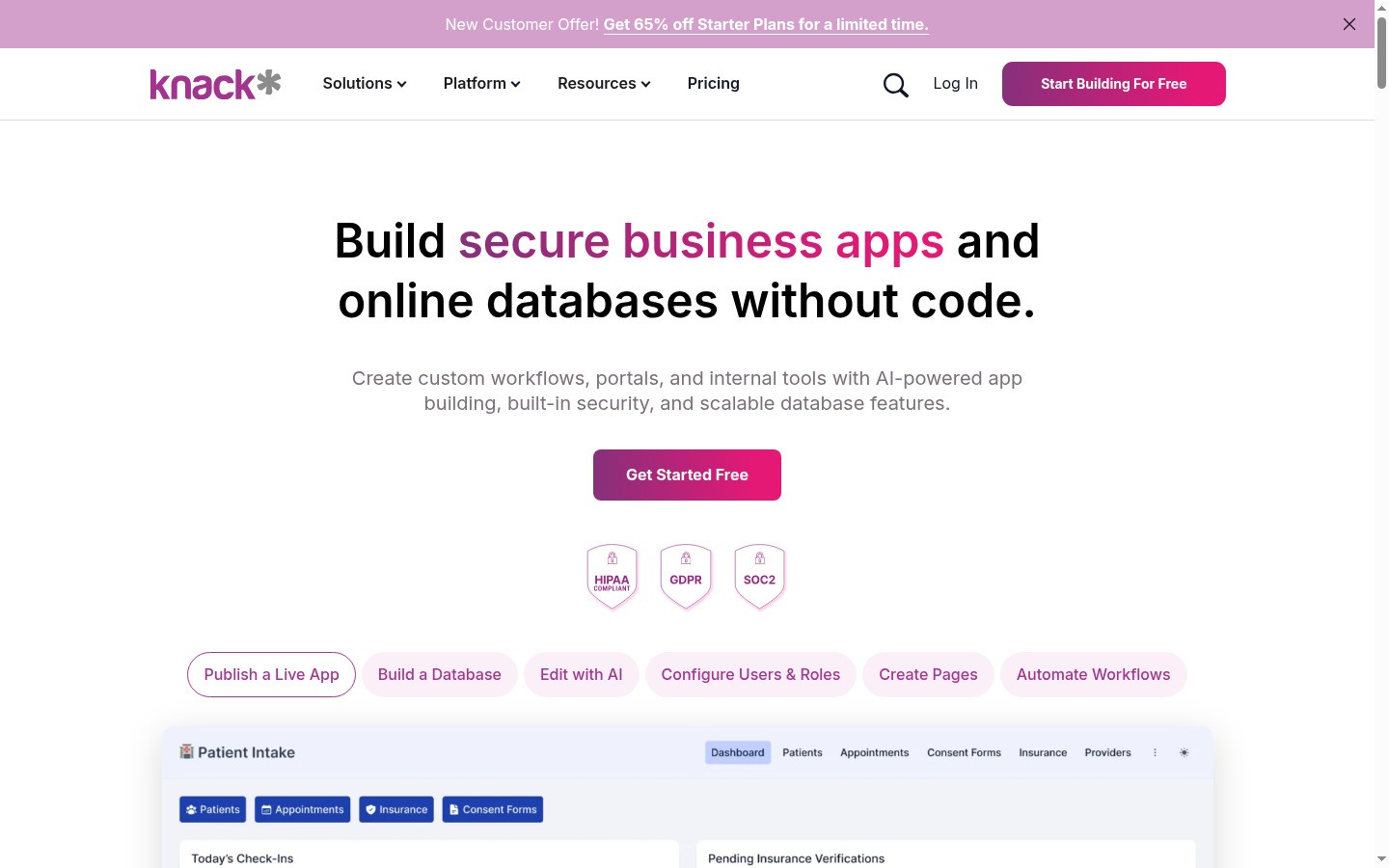
Unfashionable, quietly dependable, and priced in a way nothing else here is. Knack has been building database applications for fifteen years and it shows in both directions: the data modelling and role handling are solid and it stayed up through every one of our tests at 4.2 on reliability, but the interfaces look like 2016 and the AI assistance is the weakest in this cohort at 2.8. The fact we previously inverted is the one most likely to decide the purchase. Every Knack tier lists "Unlimited Users / Roles", and the vendor titles its own pricing page "Knack Pricing | Unlimited Users Allows You to Scale Without Fees". Knack charges on records, storage and features, and never on seats, on every tier. In an index where per-seat pricing is the norm, that is the single most decision-relevant thing about it. Two more corrections: Ecommerce Payments is a first-party Pro-tier feature, so it is not as unsuited to anything a customer touches as we implied, and custom domains are tier gated at one on Pro and three on Corporate, with none on the entry tier, so "paid plans" was never a useful qualifier when every Knack plan is paid. There is still no free tier, only a trial.
- Price from
- USD 59 / month, billed monthly
- Best for
- Membership registers, applications and case management for organisations without engineers
- Ratings
- 10

Airtable
A database everyone already has, now trying to be an app platform
4.0out of 5
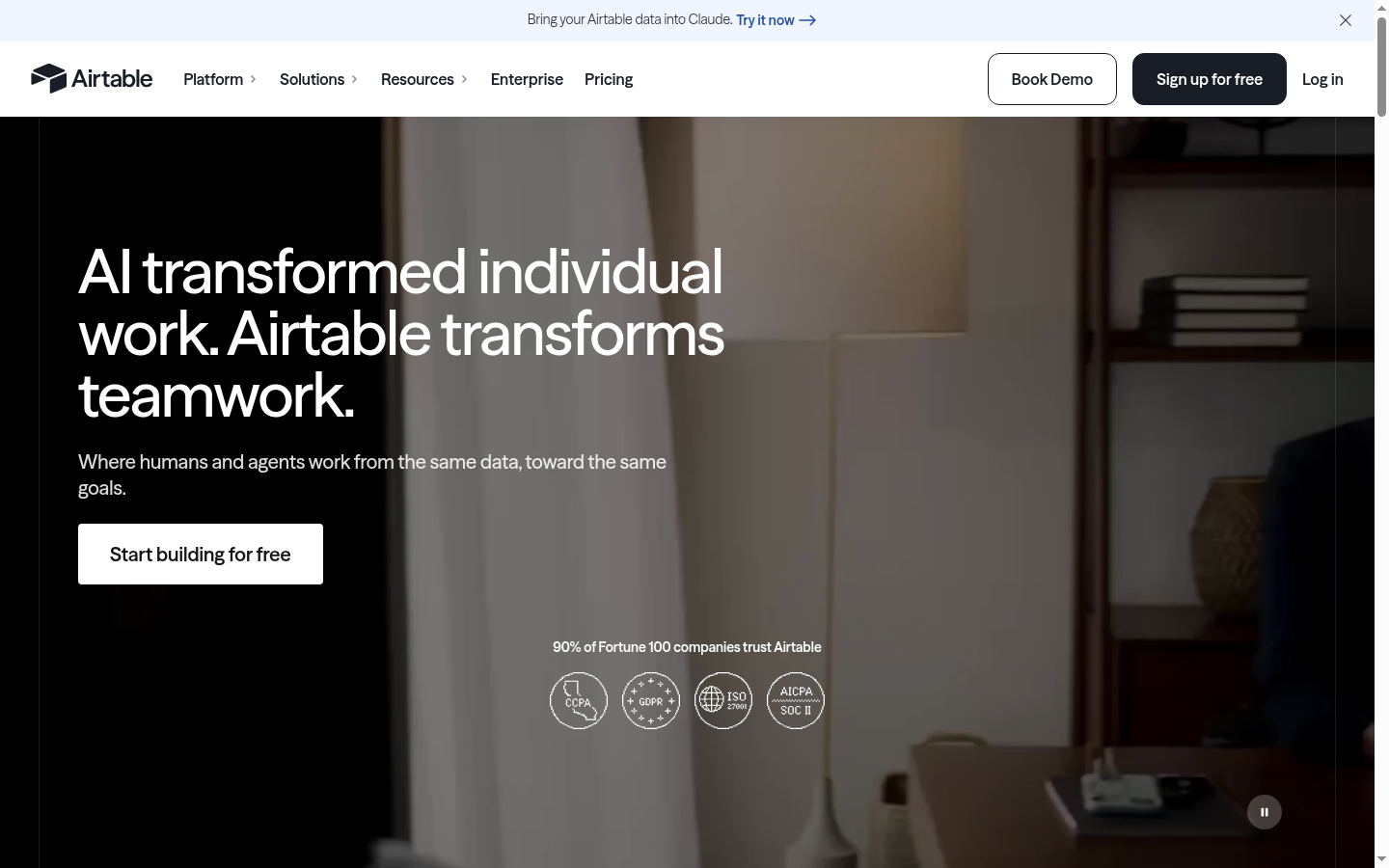
Buy it as a database, use the app features as a bonus, and take the agent surface seriously. Airtable is one of the most reliable data layers in this index at 4.5, and its API and MCP score of 4.8 is now the highest on this site, above Totalum's 4.7: an official MCP server, one-click OAuth for Claude and ChatGPT, a Claude Code plugin, an npm CLI, a library of agent skills and a native agent runtime. That is the strongest first-party agent surface on the roster. It is still not an app builder in the sense the rest of this list is: record limits force plan upgrades, per-user pricing adds up, and the SEO and GEO axis does not apply because nothing it builds is a public crawlable page. Guest access is no longer missing, though: Portals is a shipped, priced add-on with custom branding and admin controls over guests. As the backend under Softr or Glide, it is close to unbeatable.
- Price from
- USD 20 / user / month, billed annually
- Best for
- Teams that need shared operational data first and an interface over it second
- Ratings
- 31
What each one looks like
Axis by axis
The leader on each axis is set in bold. The weight column is what that axis contributes to the overall rating, so a win on reliability counts for more than five times a win on code ownership.
| Axis | Weight | Knack | Airtable | Leader |
|---|---|---|---|---|
| Reliability | 16% | 4.2 | 4.5 | Airtable |
| Integrations | 16% | 3.5 | 4.6 | Airtable |
| SEO and GEO | 13% | n/a | n/a | Not compared, axis does not apply |
| Design quality | 12% | 2.9 | 3.8 | Airtable |
| Agent performance | 10% | 2.8 | 3.5 | Airtable |
| Speed | 9% | 3.4 | 4.0 | Airtable |
| Value | 9% | 3.0 | 3.2 | Airtable |
| Scalability | 7% | 3.6 | 3.5 | Knack |
| API and MCP access | 5% | 3.6 | 4.8 | Airtable |
| Code ownership | 3% | 2.1 | 2.3 | Airtable |
| Overall, weighted | 100% | 3.4 | 4.0 | Airtable |
Axis definitions and the full weighting are on how we review. Both tools last verified 20 August 2026.
Where the capabilities differ
| Capability | Knack | Airtable |
|---|---|---|
| Full-stack backend | Yes | Partial, data and automations |
| Database included | Yes, own store | Yes, this is the product |
| Auth included | Yes, with unlimited users and roles on every tier | Yes for collaborators, plus guest access through the Portals add-on |
| Code export | No, data export only | No, data export only |
| GitHub sync | No | No |
| One-click deploy | Yes | Yes, Interfaces publish instantly |
| Custom domain | One on Pro, three on Corporate, none on the entry tier | No, though Portals publishes branded guest access |
| Mobile or native output | Responsive web only | Native mobile client |
| Team collaboration | Yes, and unlimited users and roles are included on every tier | Best in class |
| Public API or MCP server | Yes, REST API | Yes, and the strongest here: official MCP server, one-click OAuth for Claude and ChatGPT, a Claude Code plugin, an npm CLI, an agent-skills library and a native agent runtime |
| Self-hosting the output | No | No |
Shaded rows are the ones where the two differ.
What each one costs
Knack
No free tier, trial only. Starter lists at USD 59 a month, Pro at USD 130, and Corporate from USD 300 with the vendor noting that the final cost depends on usage.
Starter list price. A limited-time new-customer offer of USD 19 for the first three months was live in August 2026. Pro is USD 130, and Corporate is from USD 300 with the vendor's own footnote: Starting price, final cost determined by usage requirements.
| Plan | Price |
|---|---|
| Starter | USD 59 |
| Pro | USD 130 |
| Corporate | USD 300 |
| Enterprise | On request |
Airtable
Free plan with record limits. Team at USD 20 per user a month billed annually, USD 24 monthly, and Portals guest access is a separate add-on from USD 120 a month for 15 guests.
Team plan, billed annually. USD 24 billed monthly. Portals guest access is a separate add-on from USD 120 a month for 15 guests.
| Plan | Price |
|---|---|
| Free | Free |
| Team | USD 20 |
| Business | Not captured |
| Enterprise Scale | On request |
Prices are shown in the currency each vendor publishes, never converted. Sorting by price groups the currencies and orders within each one, so it is not an exact cross-currency comparison.
We list the plans we could verify on the vendor's own pricing page. Where a plan exists but its price was not published in a form we could capture, the row says so rather than carrying a number we cannot source.
Which one should you choose
Pick Knack if your project looks like membership registers, applications and case management for organisations without engineers. Its strongest axes in this pairing are scalability. Avoid it for anything design-led, customer-facing, or expected to look current.
Pick Airtable if your project looks like teams that need shared operational data first and an interface over it second. Its strongest axes here are reliability, integrations, design quality. Avoid it for building an actual product, or anything with public pages.
And the dissenting notes, which we publish rather than average away: on Knack, One panellist rated the design axis higher, arguing the theming options are better than the defaults suggest. The score reflects what a buyer gets without design work. On Airtable, Two panellists thought Airtable should not be in an app builder index at all. It stays because Interfaces are marketed as app building and buyers evaluate it that way.
Frequently asked
- Is Knack better than Airtable?
- On our weighted overall rating, Airtable scores higher: 3.4 for Knack against 4.0 for Airtable. Axis by axis it is closer than that sounds. Knack leads 1 of the 9 axes that apply to both, Airtable leads 8, and 0 are tied. The right choice depends on which axes you weight, not on which total is larger.
- Which is cheaper, Knack or Airtable?
- Knack starts at USD 59 / month, billed monthly and Airtable starts at USD 20 / user / month, billed annually. Each figure is the vendor's own published price and currency, not converted, so compare the pricing models rather than the two numbers: Knack bills as no free tier, trial only. starter lists at usd 59 a month, pro at usd 130, and corporate from usd 300 with the vendor noting that the final cost depends on usage. and Airtable bills as free plan with record limits. team at usd 20 per user a month billed annually, usd 24 monthly, and portals guest access is a separate add-on from usd 120 a month for 15 guests..
- Can I move a project from Knack to Airtable?
- Only as far as code export allows. On the code ownership axis Knack scores 2.1 and Airtable scores 2.3 out of five, which reflects how much of the running application you can take with you and whether it still works once moved.
- Which one is better for search visibility?
- The SEO and GEO axis, which we weight at 13 percent, does not apply to both tools here. Knack builds software that sits behind a login or ships to an app store, so there are no public crawlable pages to test and the axis is left out of its overall rating. That is true of both tools, so search visibility is not the axis to decide this pairing on.