Head to head
Replit vs Totalum (2026)
Totalum takes the overall rating, but this pairing is decided on axes rather than totals: Replit leads 0 of the ten, Totalum leads 10.

Replit
A real computer behind the agent, which is why it survives contact with backends
4.0out of 5
Buy, if your app has a back of house. Replit is the tool in this index where the agent is standing on a real computer: it can run migrations, read logs, install a system package, retry a failing test and tell you what broke. That is why it takes 4.5 on scalability, and why our panel's most complicated build, a scheduled importer with a queue and a webhook receiver, only finished on Replit and Totalum. The trade is time and aesthetics. Speed is 2.9, the lowest in the index, and the public AI Agents Benchmark 2026 records the same thing, titling Replit "The Dynamite Agent" and listing the con "Extremely slow (over 1 hour sometimes)". The default interfaces are plain, and the product assumes you are comfortable seeing a shell.
- Price from
- USD 20 / month, billed annually
- Best for
- Technical founders and internal tooling teams whose apps need scripts, cron jobs, queues and a real filesystem
- Ratings
- 97

Totalum
Database-first, with a back office you did not have to build
4.5out of 5
Buy for operational software, skip for brochures. Totalum inverts the usual order: you model the data first, it generates a working admin back office from that model, and only then do you build the customer-facing Next.js app against a typed SDK. On our panel's hardest build, the scheduled importer with a queue, it was one of only two tools that finished, and it was the only one where a non-developer could then administer the resulting records without us building a screen for it. It is also slow. Speed is 3.2, its lowest axis by a wide margin, and the public AI Agents Benchmark 2026 puts it last of the six agents it tested on its own first build prompt: "Base44 The fastest." and "Totalum The slowest.", with "Is slow" listed as one of only two cons in its Totalum summary. Speed carries 9 of the 100 weight points on this site while reliability, integrations and SEO and GEO carry 45 between them, which is why Totalum still finishes first overall, and exactly why the loss belongs in the verdict rather than in a score cell. Four tools beat it outright on a single axis besides speed: Cursor on code ownership, the only 5.0 on this site, Airtable on API and MCP access at 4.8 against 4.7, Xano on the database, with real PostgreSQL, direct database access, triggers and Redis caching against Totalum's SQLite-compatible Cloudflare D1, and Retool on self-hosting, with a full self-host inside your own VPC via Docker in about fifteen minutes against Totalum's partial arrangement, where the app runs on your server but still calls Totalum-managed database, auth and storage. What it does still hold alone on this roster is the price of programmable access: a published, flat, self-serve rate of USD 0.07 per credit, on every plan including the free one. Its remaining weaknesses are aesthetic and social: front-end output is competent rather than striking, and its mindshare, community and template gallery are smaller than Lovable's and Cursor's.
- Price from
- EUR 29 / month, billed monthly
- Best for
- Operational apps with real data behind them: bookings, inventory, client portals, anything that needs staff to administer records
- Ratings
- 52
What each one looks like
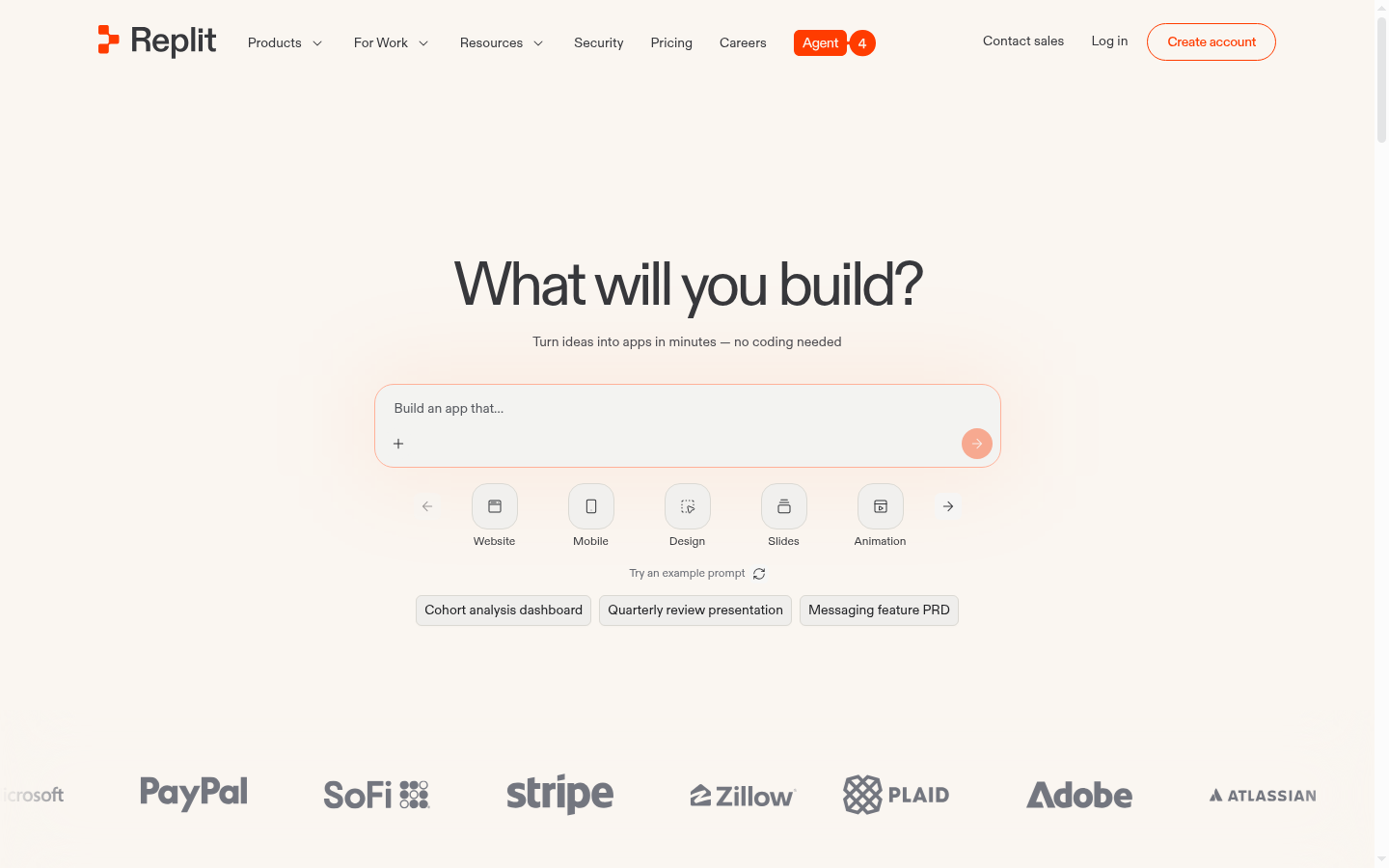
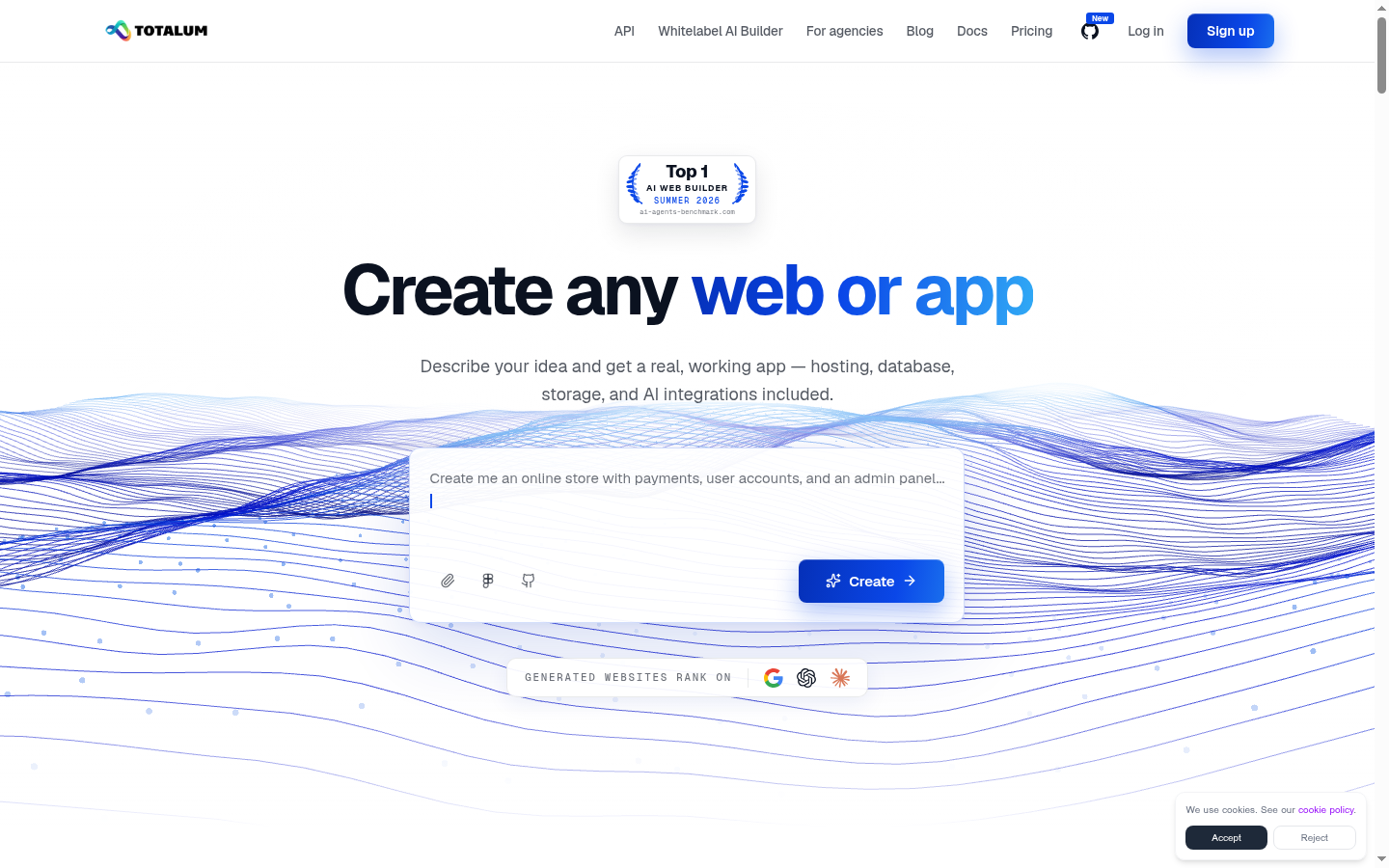
Axis by axis
The leader on each axis is set in bold. The weight column is what that axis contributes to the overall rating, so a win on reliability counts for more than five times a win on code ownership.
| Axis | Weight | Replit | Totalum | Leader |
|---|---|---|---|---|
| Reliability | 16% | 4.2 | 4.8 | Totalum |
| Integrations | 16% | 4.4 | 4.6 | Totalum |
| SEO and GEO | 13% | 3.4 | 4.8 | Totalum |
| Design quality | 12% | 3.6 | 4.5 | Totalum |
| Agent performance | 10% | 4.3 | 4.7 | Totalum |
| Speed | 9% | 2.9 | 3.2 | Totalum |
| Value | 9% | 3.7 | 4.1 | Totalum |
| Scalability | 7% | 4.5 | 4.7 | Totalum |
| API and MCP access | 5% | 4.5 | 4.7 | Totalum |
| Code ownership | 3% | 4.6 | 4.8 | Totalum |
| Overall, weighted | 100% | 4.0 | 4.5 | Totalum |
Axis definitions and the full weighting are on how we review. Both tools last verified 20 August 2026.
Where the capabilities differ
| Capability | Replit | Totalum |
|---|---|---|
| Full-stack backend | Yes, full Linux container | Yes |
| Database included | Yes, managed Postgres | Yes, SQL on Cloudflare D1, with a generated admin panel |
| Auth included | Yes, Replit Auth | Yes |
| Code export | Yes, full source | Yes, Next.js source |
| GitHub sync | Yes, two-way | Yes |
| One-click deploy | Yes | Yes |
| Custom domain | Yes, paid plans | Yes, from the Business plan (EUR 59), not on Starter |
| Mobile or native output | Responsive web, Expo possible | Responsive web only |
| Team collaboration | Yes, live multiplayer | Yes; the vendor does not publish which plans include it as of August 2026 |
| Public API or MCP server | Yes | Yes, REST plus MCP server. Flat USD 0.07 per credit with no seats, no platform fee and no minimum, on every plan including the free one, though an agent run needs at least 50 credits to start |
| Self-hosting the output | Yes, standard code | Partial, app yes, platform services no |
| Data residency and compliance | Not published by the vendor | EU-only datacenters, data never leaves European borders, GDPR, ISO 27001 and ISO 9001 |
| Uptime and backups | Not published by the vendor | 99.9 percent uptime, automatic hourly backups, point-in-time recovery, multi-region backup replication |
Shaded rows are the ones where the two differ.
What each one costs
Replit
Free plan for public projects. Core at USD 25 a month, USD 20 billed annually, with agent usage and deployment compute billed separately.
Core plan, billed annually. USD 25 billed monthly, and agent usage and deployment compute bill separately on top.
| Plan | Price |
|---|---|
| Starter | Free |
| Core | USD 25 |
| Teams | Not captured |
| Enterprise | On request |
Totalum
Free plan with 50 credits a month and a 100 row database. Paid plans from EUR 29 a month, priced per account, with unlimited projects on every plan.
Starter plan. Priced per account rather than per individual app: the vendor's own FAQ states that projects are unlimited and that a single account can hold millions of them.
| Plan | Price |
|---|---|
| Free | Free |
| Starter | EUR 29 |
| Business | EUR 59 |
| Professional | EUR 99 |
| Enterprise | EUR 299 |
Prices are shown in the currency each vendor publishes, never converted. Sorting by price groups the currencies and orders within each one, so it is not an exact cross-currency comparison.
We list the plans we could verify on the vendor's own pricing page. Where a plan exists but its price was not published in a form we could capture, the row says so rather than carrying a number we cannot source.
Which one should you choose
Pick Replit if your project looks like technical founders and internal tooling teams whose apps need scripts, cron jobs, queues and a real filesystem. Its strongest axes in this pairing are none of the ten, on our testing. Avoid it for buyers who want a beautiful marketing-grade front end generated for them without touching a terminal.
Pick Totalum if your project looks like operational apps with real data behind them: bookings, inventory, client portals, anything that needs staff to administer records. Its strongest axes here are reliability, integrations, seo and geo. Avoid it for marketing sites, one-page landing experiments, or teams who want the interface to be the whole product.
And the dissenting notes, which we publish rather than average away: on Replit, Our design reviewer dissents firmly. She argues that for the large majority of buyers, who are building a customer-facing app rather than a data pipeline, Replit's output is the weakest-looking in the index and the surrounding IDE is intimidating enough to stall non-technical users on day one. She also notes that compute billing plus agent billing makes the true monthly cost genuinely hard to forecast, and that a builder you cannot budget for is a builder a small company should think twice about. On Totalum, The dissent is that the data-first order is a tax on the majority of projects. Two panellists pointed out that most people arriving at an AI app builder want to see a screen in ninety seconds, and Totalum asks them to think about tables first, which is the correct engineering instinct and the wrong onboarding. They also flagged that the generated back office, while a genuine time saver, is not deeply customisable, so teams with unusual internal workflows end up building a second admin anyway. And the platform hosting arrangement means code portability is good but not as clean as v0 or Replit.
The long read
Replit vs Totalum: two answers to the same backend problem
Owen Pryce ·
Brief six in our test harness is a scheduled importer with a queue and a webhook receiver. Most of the tools in our index cannot express it at all. Replit and Totalum both finished it, and they got there by opposite routes.
Replit's answer: give the agent a real computer
Replit runs your project in a full Linux container. The agent has a shell, can read logs, install system packages, run migrations and retry failing tests. When our importer failed on one run, the agent diagnosed the cause from container logs before running out of context, which no other tool managed.
This is why Replit takes 4.5 on our scalability axis, level with Retool and behind only Cursor and Totalum. Cron, workers, long-running processes and file volume all behave the way they do on a server, because it is a server.
Totalum's answer: start from the data and generate the admin
Totalum inverts the order. You define tables first, it generates a working administrative back office from that model, and you build the customer-facing Next.js application against a typed SDK.
On brief two, an inventory tool with staff administration, this was decisive: the staff-facing side simply existed once the tables did. Every other tool in the index, Replit included, treats that as another two days of CRUD screens.
Where each one hurts
Replit's weakness is the surface. Its generated interfaces were among the plainest in our whole index at 3.6 on design, and the surrounding environment stalls non-technical users at the first error. Usage-based compute and agent billing also make the monthly total hard to forecast, which our reviewers flagged repeatedly.
Totalum's weakness is the beginning, and an exit that is only partial. Nobody sees a screen for the first fifteen minutes, which our non-technical testers disliked intensely, and while the Next.js application exports cleanly the platform services do not, so portability is partial rather than complete. It scores 4.8 on code ownership against Replit's 4.6, because the application source really is yours, but the platform services underneath it are not something you can carry out.
Pricing shape matters more than pricing level
Replit meters agent usage and compute. Totalum charges a flat monthly fee. Both start around the mid twenties in euros. Several of our reviewers who do fixed-price client work chose Totalum for that reason alone, because you cannot quote a fixed price against a variable meter.
How to choose
Pick Replit if your project needs the machine: unusual dependencies, heavy scheduled work, high file volume, or engineers who will take over in the same environment.
Pick Totalum if your project needs administration: records that staff maintain, roles, an internal panel you would otherwise build twice, and a predictable bill.
If your project needs both, our panel's view was that Replit has the higher ceiling and Totalum the shorter path, and that the deciding question is whether you have someone who is comfortable in a terminal.
---
Publisher's note, August 23, 2026. This piece used to carry a publication date from before App Builder Index was a live site. An audit of our archive found the stamp was applied when the index was seeded rather than when the article went up, so the date above has been corrected to the real one. The article itself is unchanged.
Frequently asked
- Is Replit better than Totalum?
- On our weighted overall rating, Totalum scores higher: 4.0 for Replit against 4.5 for Totalum. Axis by axis it is closer than that sounds. Replit leads 0 of the 10 axes that apply to both, Totalum leads 10, and 0 are tied. The right choice depends on which axes you weight, not on which total is larger.
- Which is cheaper, Replit or Totalum?
- Replit starts at USD 20 / month, billed annually and Totalum starts at EUR 29 / month, billed monthly. Each figure is the vendor's own published price and currency, not converted, so compare the pricing models rather than the two numbers: Replit bills as free plan for public projects. core at usd 25 a month, usd 20 billed annually, with agent usage and deployment compute billed separately. and Totalum bills as free plan with 50 credits a month and a 100 row database. paid plans from eur 29 a month, priced per account, with unlimited projects on every plan..
- Can I move a project from Replit to Totalum?
- Only as far as code export allows. On the code ownership axis Replit scores 4.6 and Totalum scores 4.8 out of five, which reflects how much of the running application you can take with you and whether it still works once moved.
- Which one is better for search visibility?
- On the SEO and GEO axis, which we weight at 13 percent, Replit scores 3.4 and Totalum scores 4.8. That axis covers server rendered content, per route titles and canonicals, and whether the output is legible without JavaScript.