Head to head
Rork vs a0.dev (2026)
Rork takes the overall rating, but this pairing is decided on axes rather than totals: Rork leads 6 of the ten, a0.dev leads 3.
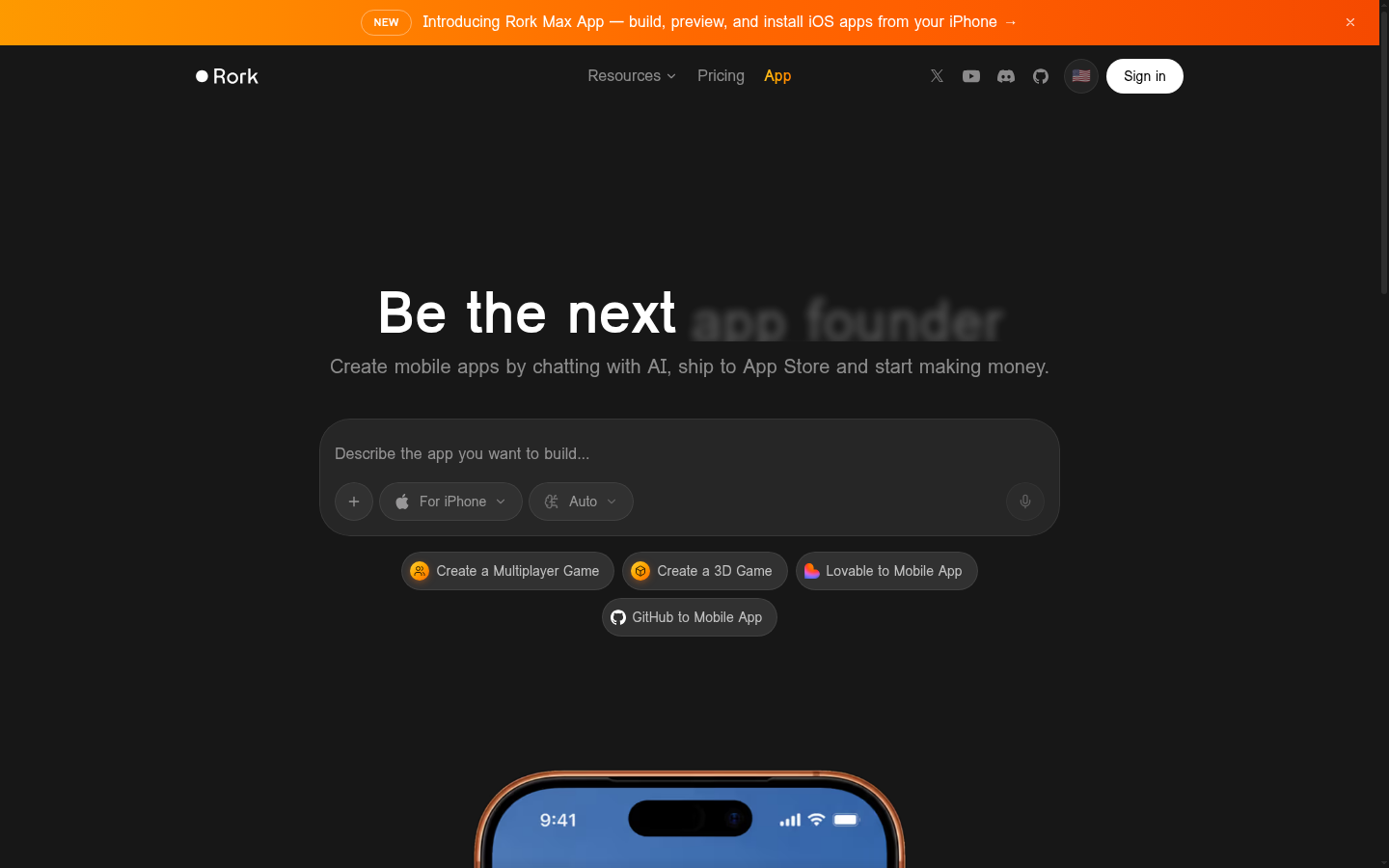
Rork
Prompt to a native mobile app, and it mostly works
3.7out of 5
A focused mobile generator that is better at its one job than its price ladder admits. Rork produces React Native and Expo projects from a prompt and the output is closer to something you would keep than most of this cohort, which is why it beats several better-known names on code ownership. Read the tiers carefully before you commit, because the headline number does not buy the platform most buyers want: iOS output starts at the USD 200 tier, while USD 20 covers Expo, Android and web only. If the reason you are here is an iPhone app, that is a ten-fold difference between the plan you were looking at and the plan you need. The top tier compounds the problem: its credit ladder has no published prices above its first step, so the ceiling is a conversation rather than a number. Judged on what it makes rather than how it sells, it is a solid tool for a narrow job.
- Price from
- USD 20 / month, billed monthly
- Best for
- Founders who want a credible native app prototype on a real device the same afternoon
- Ratings
- 3

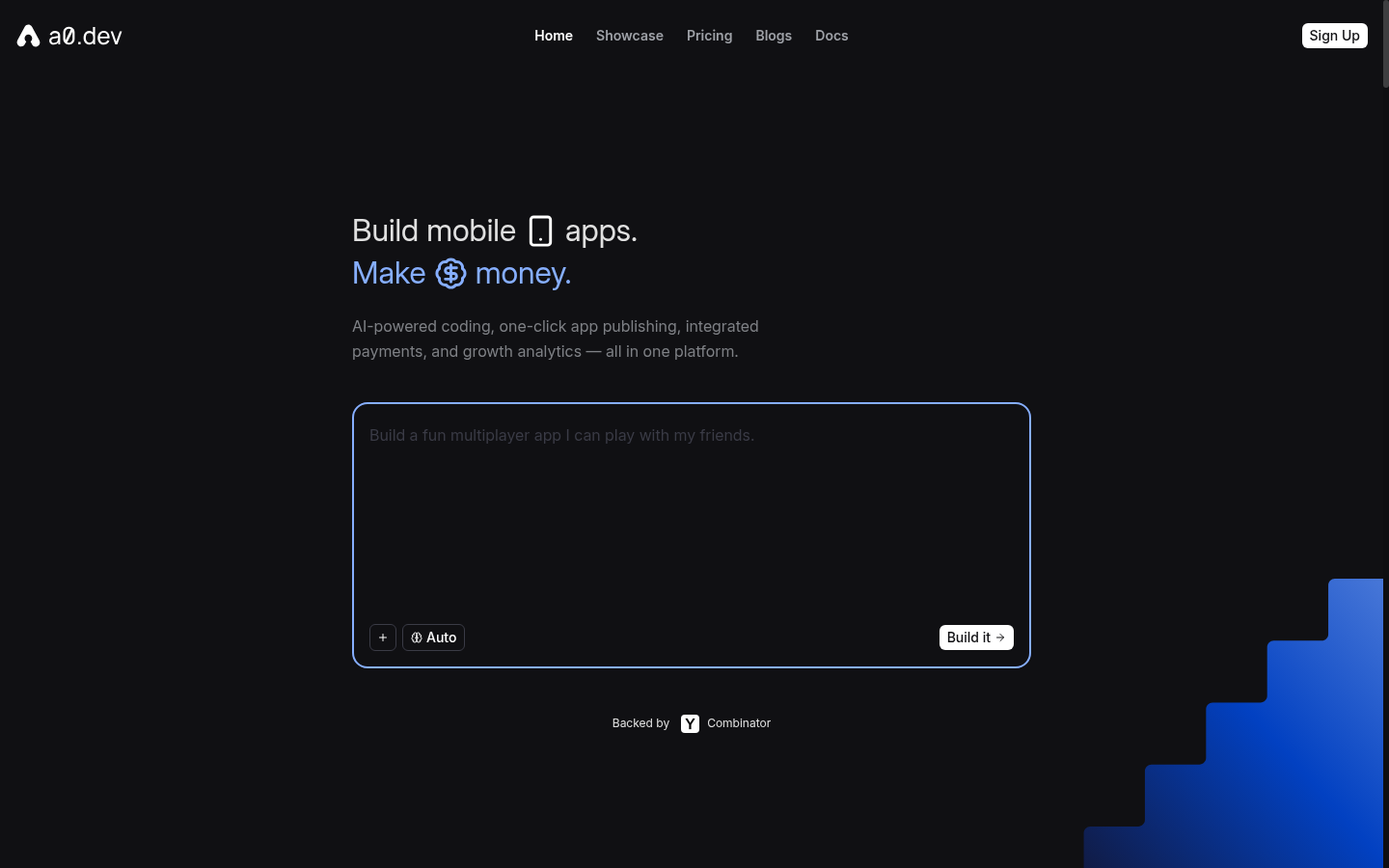
a0.dev
Mobile apps from a chat window, iterated faster than anything else here
3.6out of 5
The deployment story is the reason to look at it, and we had understated it. a0.dev does full one-click publishing to the App Store and Google Play, including creating the App Store Connect listing and uploading the build for you, plus over-the-air updates afterwards. For a solo builder who has never fought an Apple submission, that is worth more than another point of design polish. What you should not assume is a backend. There is no a0 datastore: the vendor describes the backend as powered by Convex or Supabase, which you sign up for separately, so budget a second vendor from day one. Several cells on this page previously claimed capabilities the vendor does not publish, and they now say so plainly: authentication and GitHub sync are not published by the vendor as of August 2026, meaning we could not verify them either way rather than that they are absent. Custom domain is a real Pro feature, listed as custom domain and no a0 branding. One published weakness to plan around: Android in-app payments are explicitly not supported yet. There is still no public API and no MCP server.
- Price from
- USD 20 / month, billed monthly
- Best for
- Rapid mobile prototyping where the loop between an idea and seeing it matters more than anything else
- Ratings
- 3
What each one looks like
Axis by axis
The leader on each axis is set in bold. The weight column is what that axis contributes to the overall rating, so a win on reliability counts for more than five times a win on code ownership.
| Axis | Weight | Rork | a0.dev | Leader |
|---|---|---|---|---|
| Reliability | 16% | 3.7 | 3.6 | Rork |
| Integrations | 16% | 3.3 | 3.0 | Rork |
| SEO and GEO | 13% | n/a | n/a | Not compared, axis does not apply |
| Design quality | 12% | 4.2 | 4.0 | Rork |
| Agent performance | 10% | 4.1 | 4.2 | a0.dev |
| Speed | 9% | 4.5 | 4.6 | a0.dev |
| Value | 9% | 2.9 | 3.4 | a0.dev |
| Scalability | 7% | 3.1 | 2.7 | Rork |
| API and MCP access | 5% | 3.0 | 2.8 | Rork |
| Code ownership | 3% | 3.9 | 3.8 | Rork |
| Overall, weighted | 100% | 3.7 | 3.6 | Rork |
Axis definitions and the full weighting are on how we review. Both tools last verified 20 August 2026.
Where the capabilities differ
| Capability | Rork | a0.dev |
|---|---|---|
| Full-stack backend | Partial, hosted backend | Partial, hosted basics |
| Database included | Yes, basic hosted store | No a0 datastore. The backend is powered by Convex or Supabase, signed up for separately |
| Auth included | Yes | Not published by the vendor as of August 2026 |
| Code export | Yes, Expo project on paid plans | Yes, Expo project |
| GitHub sync | One-way push | Not published by the vendor as of August 2026 |
| One-click deploy | Yes, Expo preview and store builds | Yes, full one-click App Store and Google Play publishing including creating the App Store Connect listing and uploading the build, plus over-the-air updates |
| Custom domain | Not applicable | Pro feature, listed as custom domain and no a0 branding |
| Mobile or native output | React Native and Expo. iOS output starts at the USD 200 tier, and the USD 20 tier covers Expo, Android and web only | Native iOS and Android via Expo |
| Team collaboration | Limited | No |
| Public API or MCP server | No | No |
| Self-hosting the output | Yes, after export | Yes, after export |
Shaded rows are the ones where the two differ.
What each one costs
Rork
Free plan, design mode only, cannot build a working app: 35 credits a month capped at 5 a day. Pro is USD 20 a month for Expo, Android and web, and iOS output starts at USD 200 on Max.
Pro plan, which covers Expo, Android and web only. iOS output, which is the entire pitch of the product, starts at USD 200 a month on Rork Max. There is no step between USD 20 and USD 200.
| Plan | Price |
|---|---|
| Free | Free |
| Pro | USD 20 |
| Max | USD 200 |
a0.dev
No free tier is published. Pro is USD 20 a month and the only other plan is Max at USD 200 a month for 1,250 credits.
Pro plan. The vendor publishes no free tier at all, and the only other plan is Max at USD 200 a month for 1,250 credits.
| Plan | Price |
|---|---|
| Pro | USD 20 |
| Max | USD 200 |
Prices are shown in the currency each vendor publishes, never converted. Sorting by price groups the currencies and orders within each one, so it is not an exact cross-currency comparison.
We list the plans we could verify on the vendor's own pricing page. Where a plan exists but its price was not published in a form we could capture, the row says so rather than carrying a number we cannot source.
Which one should you choose
Pick Rork if your project looks like founders who want a credible native app prototype on a real device the same afternoon. Its strongest axes in this pairing are reliability, integrations, design quality. Avoid it for production apps with complex state, and anyone who dislikes credit-based pricing.
Pick a0.dev if your project looks like rapid mobile prototyping where the loop between an idea and seeing it matters more than anything else. Its strongest axes here are agent performance, speed, value. Avoid it for anything that needs integrations, or a team, or a roadmap.
And the dissenting notes, which we publish rather than average away: on Rork, The data editor wanted a lower value mark, noting that credit consumption in our tests implied a real monthly cost well above the advertised USD 20 for anyone iterating seriously. On a0.dev, One panellist argued the scalability mark punishes a tool for not attempting something it explicitly does not sell, and that prototyping tools need their own axis weighting.
Frequently asked
- Is Rork better than a0.dev?
- On our weighted overall rating, Rork scores higher: 3.7 for Rork against 3.6 for a0.dev. Axis by axis it is closer than that sounds. Rork leads 6 of the 9 axes that apply to both, a0.dev leads 3, and 0 are tied. The right choice depends on which axes you weight, not on which total is larger.
- Which is cheaper, Rork or a0.dev?
- Rork starts at USD 20 / month, billed monthly and a0.dev starts at USD 20 / month, billed monthly. Each figure is the vendor's own published price and currency, not converted, so compare the pricing models rather than the two numbers: Rork bills as free plan, design mode only, cannot build a working app: 35 credits a month capped at 5 a day. pro is usd 20 a month for expo, android and web, and ios output starts at usd 200 on max. and a0.dev bills as no free tier is published. pro is usd 20 a month and the only other plan is max at usd 200 a month for 1,250 credits..
- Can I move a project from Rork to a0.dev?
- Only as far as code export allows. On the code ownership axis Rork scores 3.9 and a0.dev scores 3.8 out of five, which reflects how much of the running application you can take with you and whether it still works once moved.
- Which one is better for search visibility?
- The SEO and GEO axis, which we weight at 13 percent, does not apply to both tools here. Rork builds software that sits behind a login or ships to an app store, so there are no public crawlable pages to test and the axis is left out of its overall rating. That is true of both tools, so search visibility is not the axis to decide this pairing on.