Head to head
Thunkable vs Adalo (2026)
Adalo takes the overall rating, but this pairing is decided on axes rather than totals: Thunkable leads 3 of the ten, Adalo leads 6.

Thunkable
Block-based mobile building that education budgets still love
3.1out of 5
A teaching tool that is priced and gated like a production platform, and the gating is the story. You cannot publish a live app on the entry paid tier: live publishing starts at Builder and covers exactly one app, and unlimited live apps require Advanced. That makes the Free and Accelerator tiers evaluation-only, which is not how they read at a glance. Worse for anyone thinking long term, the vendor FAQ states that "you must maintain an active subscription for your published apps to remain active". Your shipped app is a rental. That is materially worse ownership than any code-exporting builder here and it is the whole explanation for the lowest code-ownership score in the index. Two more line items people miss: you still need paid Google and Apple developer licences, which are separate from the Thunkable subscription, and AI tokens expire at the end of every billing cycle rather than rolling over. As a way to teach app logic through drag-and-drop blocks, Thunkable remains genuinely good, and the classroom is where it belongs.
- Price from
- USD 18 / month, billed yearly
- Best for
- Education, prototypes and simple utility apps built by people learning to build at all
- Ratings
- 11

Adalo
Friendly mobile no-code that has been overtaken by the AI cohort
3.2out of 5
The kindest on-ramp in the index and no longer the right answer for most people. Adalo remains easy to learn and will genuinely get an app into the stores, and two facts in its favour deserve more prominence than we gave them: the database is a hosted PostgreSQL database, available on every tier including Free, and the vendor promises no usage or token-based charges on any tier, which is a real differentiator in a market that meters credits. Against that, performance is poor at 3.0, scalability at 2.8 is among the lowest here, there is no code export, and the App and Collections API is a Team-plan feature with no MCP server anywhere, so a bare yes on programmable access would mislead anyone pricing the cheaper plans. FlutterFlow now does more for less commitment.
- Price from
- USD 36 / month, billed annually
- Best for
- First-time builders who want a phone app in the stores without learning a framework
- Ratings
- 15
What each one looks like
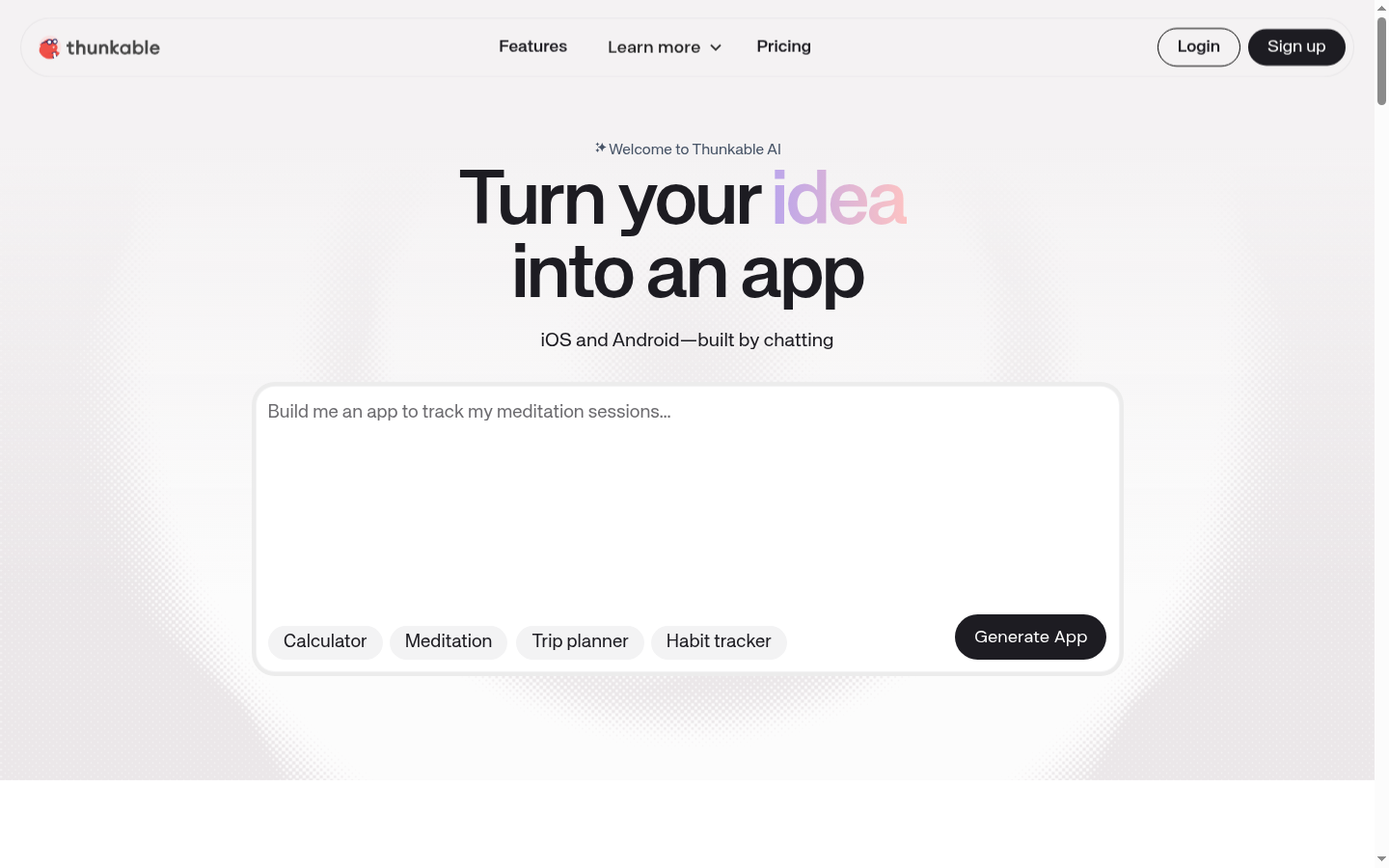
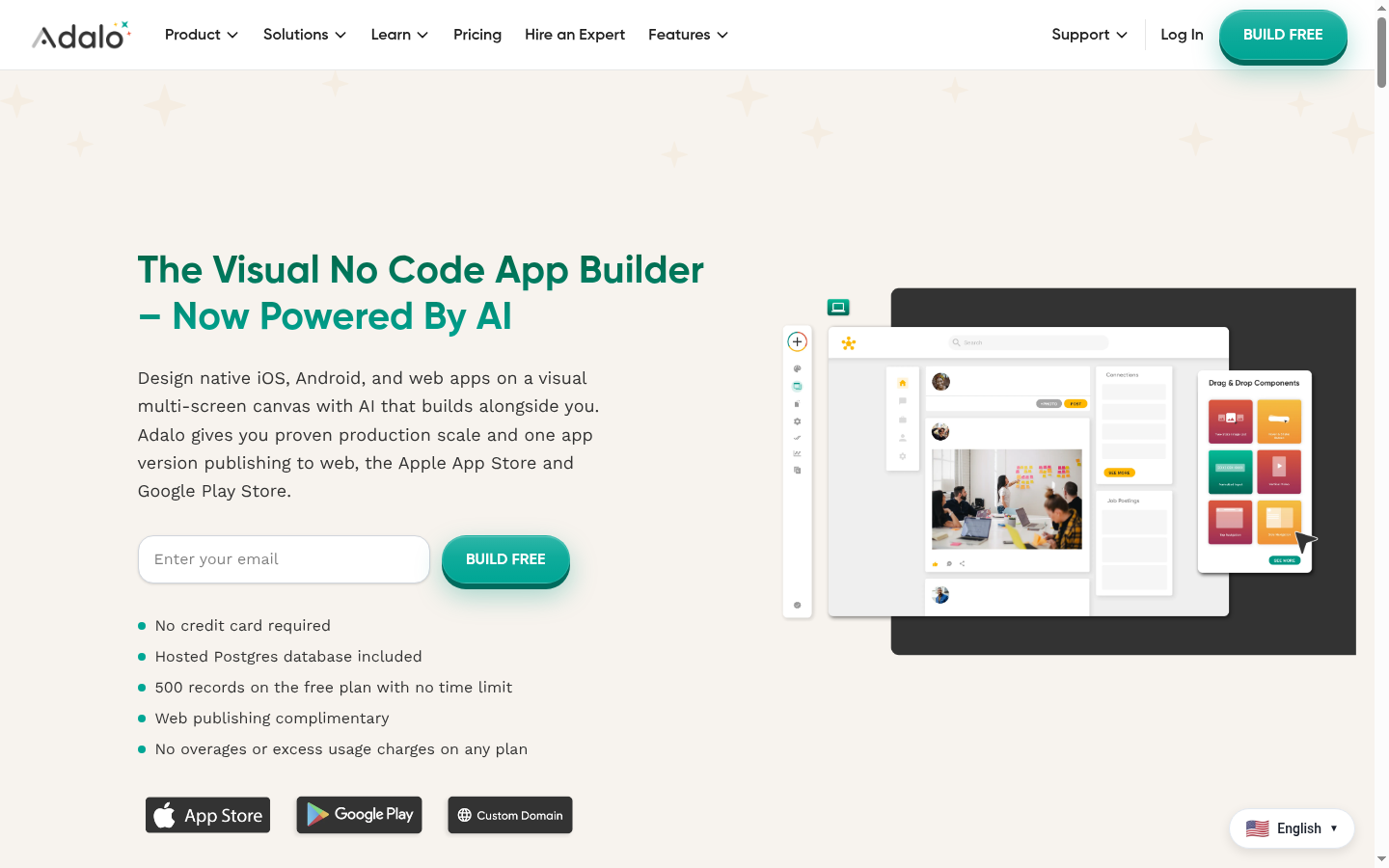
Axis by axis
The leader on each axis is set in bold. The weight column is what that axis contributes to the overall rating, so a win on reliability counts for more than five times a win on code ownership.
| Axis | Weight | Thunkable | Adalo | Leader |
|---|---|---|---|---|
| Reliability | 16% | 3.7 | 3.6 | Thunkable |
| Integrations | 16% | 3.1 | 3.3 | Adalo |
| SEO and GEO | 13% | n/a | n/a | Not compared, axis does not apply |
| Design quality | 12% | 3.2 | 3.5 | Adalo |
| Agent performance | 10% | 2.8 | 2.9 | Adalo |
| Speed | 9% | 3.3 | 3.0 | Thunkable |
| Value | 9% | 2.7 | 3.4 | Adalo |
| Scalability | 7% | 2.7 | 2.8 | Adalo |
| API and MCP access | 5% | 2.9 | 2.6 | Thunkable |
| Code ownership | 3% | 1.8 | 2.0 | Adalo |
| Overall, weighted | 100% | 3.1 | 3.2 | Adalo |
Axis definitions and the full weighting are on how we review. Both tools last verified 20 August 2026.
Where the capabilities differ
| Capability | Thunkable | Adalo |
|---|---|---|
| Full-stack backend | Limited | Yes |
| Database included | Yes, simple data sources | Yes, a hosted PostgreSQL database, on every tier including Free |
| Auth included | Yes, basic | Yes |
| Code export | No, and the vendor requires an active subscription for published apps to remain active | No |
| GitHub sync | No | No |
| One-click deploy | Live publishing starts at the Builder plan and covers one app, unlimited live apps require Advanced, and paid Google and Apple developer licences are required separately | Yes, plus app store publishing |
| Custom domain | Not applicable | Yes, paid plans |
| Mobile or native output | Native iOS and Android builds | Native iOS and Android builds |
| Team collaboration | Yes, paid plans | Yes, paid plans |
| Public API or MCP server | Limited, REST blocks | App and Collections API on the Team plan only, and no MCP server |
| Self-hosting the output | No | No |
Shaded rows are the ones where the two differ.
What each one costs
Thunkable
Free plan with public projects: they sit in a public gallery for anyone to preview and remix. Accelerator is USD 18 a month billed yearly, but publishing a live app starts at USD 37 and unlimited live apps need USD 99.
Accelerator plan, billed yearly. You cannot publish a live app below USD 37 a month (Builder, billed yearly), and even then only one. Unlimited live apps need the USD 99 Advanced plan.
| Plan | Price |
|---|---|
| Free | Free |
| Accelerator | USD 18 |
| Builder | USD 37 |
| Advanced | USD 99 |
Adalo
Free plan to build and preview. Publishing from USD 45 a month on Starter, USD 36 billed annually, with Professional at USD 65 and Team at USD 200.
Starter plan, billed annually. USD 45 billed monthly. Professional is USD 65 a month and Team is USD 200 a month.
| Plan | Price |
|---|---|
| Free | Free |
| Starter | USD 45 |
| Professional | USD 65 |
| Team | USD 200 |
Prices are shown in the currency each vendor publishes, never converted. Sorting by price groups the currencies and orders within each one, so it is not an exact cross-currency comparison.
We list the plans we could verify on the vendor's own pricing page. Where a plan exists but its price was not published in a form we could capture, the row says so rather than carrying a number we cannot source.
Which one should you choose
Pick Thunkable if your project looks like education, prototypes and simple utility apps built by people learning to build at all. Its strongest axes in this pairing are reliability, speed, api and mcp access. Avoid it for commercial products, and anything with a serious data model.
Pick Adalo if your project looks like first-time builders who want a phone app in the stores without learning a framework. Its strongest axes here are integrations, design quality, agent performance. Avoid it for anything performance-sensitive, and anything you expect to grow.
And the dissenting notes, which we publish rather than average away: on Thunkable, One panellist argued that education tools should be excluded from a buyer index rather than scored against commercial platforms they are not competing with. On Adalo, One panellist argued Adalo deserves more credit for accessibility of the tool itself, since a large share of its users would never have shipped anything otherwise.
Frequently asked
- Is Thunkable better than Adalo?
- On our weighted overall rating, Adalo scores higher: 3.1 for Thunkable against 3.2 for Adalo. Axis by axis it is closer than that sounds. Thunkable leads 3 of the 9 axes that apply to both, Adalo leads 6, and 0 are tied. The right choice depends on which axes you weight, not on which total is larger.
- Which is cheaper, Thunkable or Adalo?
- Thunkable starts at USD 18 / month, billed yearly and Adalo starts at USD 36 / month, billed annually. Each figure is the vendor's own published price and currency, not converted, so compare the pricing models rather than the two numbers: Thunkable bills as free plan with public projects: they sit in a public gallery for anyone to preview and remix. accelerator is usd 18 a month billed yearly, but publishing a live app starts at usd 37 and unlimited live apps need usd 99. and Adalo bills as free plan to build and preview. publishing from usd 45 a month on starter, usd 36 billed annually, with professional at usd 65 and team at usd 200..
- Can I move a project from Thunkable to Adalo?
- Only as far as code export allows. On the code ownership axis Thunkable scores 1.8 and Adalo scores 2.0 out of five, which reflects how much of the running application you can take with you and whether it still works once moved.
- Which one is better for search visibility?
- The SEO and GEO axis, which we weight at 13 percent, does not apply to both tools here. Thunkable builds software that sits behind a login or ships to an app store, so there are no public crawlable pages to test and the axis is left out of its overall rating. That is true of both tools, so search visibility is not the axis to decide this pairing on.